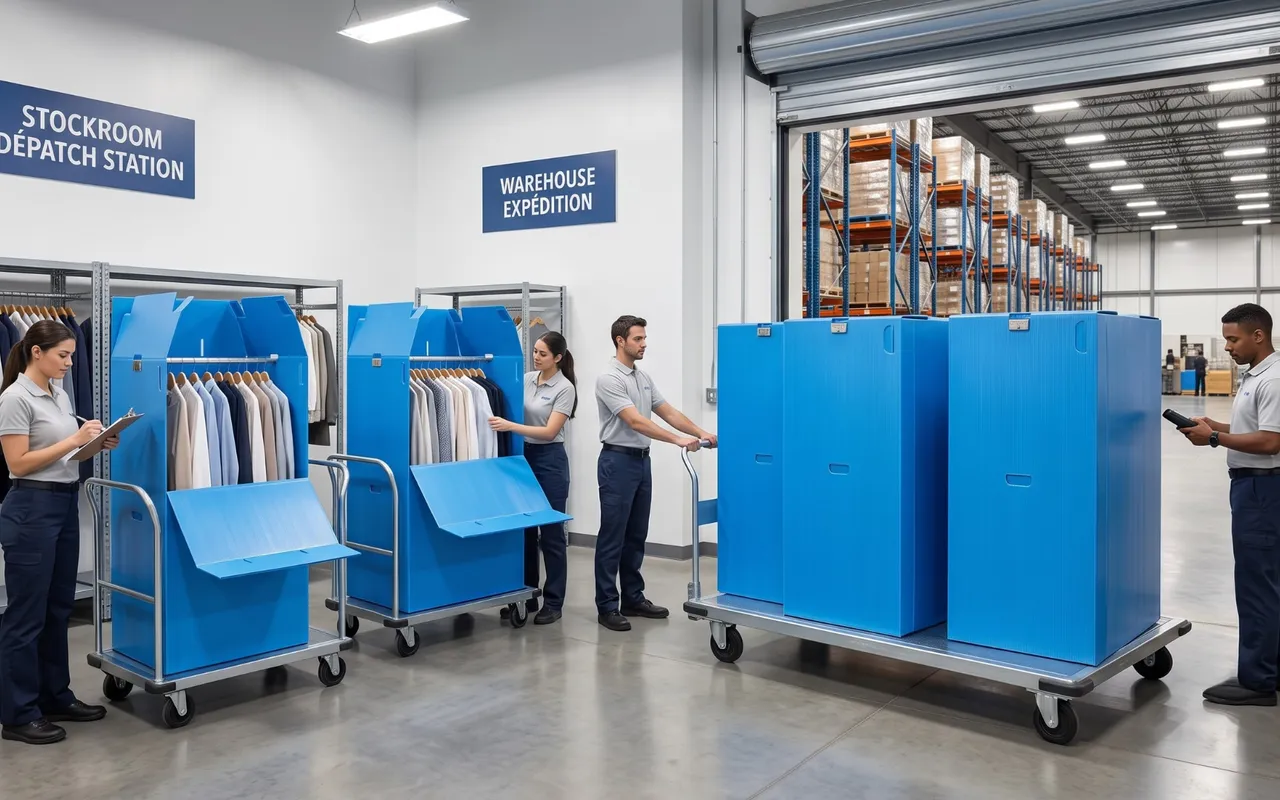
How to Protect Clothing During Transportation and Storage
Dust, moisture and crushing: the three risks to eliminate, and how to do it.

Whether garments travel an hour in a truck or sit six months in a warehouse, the threats are surprisingly similar. Only the intensity changes: transport concentrates the shocks, storage spreads the damage out slowly.
Understanding these three risks lets you pick the right container the first time, instead of discovering the damage when you pull the pieces back out.
1. Dust
The most underestimated risk. In a warehouse, dust settles continuously and works into the fibres. On light fabrics or textiles hung for long periods, it forces a full clean before reuse — a cost that returns every season.
2. Moisture
A basement, a loading dock or a concrete floor releases more moisture than people expect. Consequences range from a musty smell to mildew stains, often irreversible on natural fabrics.
This is where the container material becomes decisive: cardboard absorbs moisture and passes it to its contents, while corrugated plastic acts as a barrier.
3. Crushing
The most visible risk. A soft container or a sagging carton lets the weight spread onto the garments underneath. The result: shoulder marks, deformed collars and creases that only a press will remove.
The container makes the difference
A good container ticks three boxes: enclosed, rigid and water-resistant. Corrugated plastic does all three. It keeps its shape under load, does not soak up water and stays rigid down to ‒25 °C, which matters in an unheated warehouse or a winter delivery.
The built-in bar adds a fourth advantage: garments stay hanging, so they are never compressed by their own folds.
Best practices, in transit and in storage
- Do not overload: leave air between hangers to avoid pressure marks
- Keep boxes upright, never laid flat
- Store on pallets or shelving rather than directly on the floor, to break moisture
- Label the contents clearly so you never open a box for nothing
- Avoid sharp temperature swings, which encourage condensation
One simple check before long-term storage
Before storing for months, make sure garments are completely dry. A single damp textile contaminates everything inside a closed container. That thirty-second check prevents most unpleasant surprises at unpacking.
Protect your garments from departure to arrival: see our volume pricing.